Last updated: August 21, 2026
Somebody has been cutting neat half-circles out of your rose leaves. It looks like damage, it is not, and the culprit is one of the better pollinators you can have in a summer vegetable garden. Leafcutter bees carve those discs to line and cap their nest cells, and the scalloped edges on a rose, redbud or lilac leaf are the most reliable sign that they are working your yard.
Leafcutters are the second half of a bee hotel and the half most people never fill correctly. They want a narrower tunnel than mason bees, they nest in high summer rather than early spring, and they line their cells with leaf pieces instead of mud. Treat them as a separate season with separate tubes and a bee hotel goes from occupied for six weeks a year to occupied for most of the growing season.
This article contains affiliate links. If you buy through them, we may earn a commission at no extra cost to you. Learn more.
Quick Answer
What is a leafcutter bee house?
- The same style of housing as a mason bee house, but filled with narrower tubes, commonly around 6mm rather than the 8mm class used for spring mason bees.
- Leafcutters nest in high summer, so the tubes go out after the spring mason bee season is finished.
- They cap cells with cut leaf discs instead of mud, so no clay patch is needed.
- Removable, breathable tubes matter for the same reason they do with mason bees: you have to be able to open them.
Bottom line: a leafcutter house is a mason bee house with narrower tubes put out on a later calendar.
Who Leafcutter Bees Actually Are
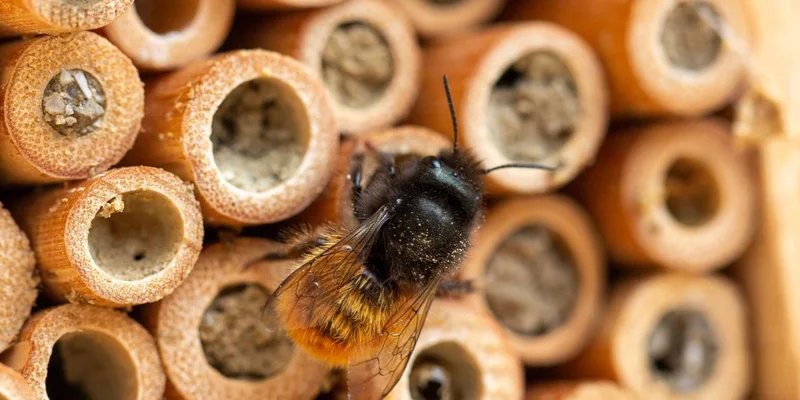
Leafcutter bees are solitary, cavity-nesting bees in the genus Megachile. Like mason bees, each female works alone: she finds a tunnel, provisions a cell with pollen and nectar, lays an egg, seals the cell, and moves on. Unlike mason bees, she builds the cell out of leaf pieces she cuts and carries back under her body.
They are stocky, dark bees that carry pollen on the underside of the abdomen rather than on the legs, which is why they look dusty gold underneath when they are working. They are also active in the heat of summer, which is exactly when the spring mason bees have finished and gone quiet.
Tube Size Is the Whole Difference
The single change that turns a mason bee house into a leafcutter house is tunnel diameter. Suppliers of solitary bee nesting material consistently split the range the same way: roughly 8mm cavities for spring mason bees and roughly 6mm cavities for summer leafcutters. Depth stays in the same six inch range for both.
Put both diameters in one panel and you will usually get mason bees in the wide holes and leafcutters in the narrow ones, which is fine. What does not work is a single mixed-size decorative hotel where most of the holes match neither, and the useful ones are outnumbered by tunnels that only attract wasps.
Timing as a Filter
If you specifically want leafcutters rather than mason bees, timing does the sorting for you. Putting the narrow tubes out after the local mason bee nesting season has finished means the spring bees never see them, and the leafcutters arrive to an empty, clean panel.
The exact date depends entirely on your region. Extension offices and local native bee groups publish emergence windows for their own area, and that is a far better guide than a national rule of thumb.

The Leaf Damage Question
The neat semicircular notches on rose, lilac, redbud and bean leaves are leafcutter work, and they are cosmetic. The bee removes a disc from the leaf edge and leaves the veins and the bulk of the leaf intact, so the plant keeps photosynthesizing. It is not a disease, not a caterpillar, and not something to spray for.
That last point matters more than the aesthetics. Insecticides applied to control the perceived damage remove the pollinator doing the cutting along with everything else visiting the garden. If the notching genuinely bothers you on a show rose, plant something they prefer nearby rather than reaching for a spray.
Mason Bees and Leafcutters Side by Side
The two species run on different calendars and different materials, which is precisely why a yard can host both without either one crowding the other out.
| Trait | Spring mason bees | Summer leafcutters | Why it matters |
|---|---|---|---|
| Tube diameter | Around 8mm class | Around 6mm class | Decides who moves in |
| Season | Early spring | Warm summer months | When tubes go out |
| Cell material | Mud | Cut leaf discs | Clay patch only needed for masons |
| Main crops served | Tree fruit and early bloom | Summer vegetables and legumes | Matches your garden calendar |
Care, Harvest and What Goes Wrong
Leafcutter nesting material accumulates the same problems as mason bee material: pollen mites, parasitic wasps, mold in tubes that cannot breathe, and birds working the front of a full panel. The same answer applies, which is nesting material you can open, replaced rather than reused.
Harvest and storage differ in one important respect. Leafcutters overwinter as larvae inside their leafy cells rather than as finished cocoons, so the handling is not identical to the mason bee routine. Follow guidance written for leafcutters specifically, from your extension service or a native bee supplier, rather than assuming the two are interchangeable. Our guide to mason bee house problems covers the pest side, which the two species do share.
Making the Yard Worth Nesting In
A house without forage nearby is an empty house. Leafcutters work a short radius, so what blooms in your own yard in July and August decides whether they stay. Legumes, sunflowers, mint family plants and most summer vegetables all pull them in, and so does anything with an open, accessible flower.
They also need leaf material they can cut, which means keeping some soft-leaved plants unsprayed and within easy flight. Our guide to what to plant near the hives covers the bloom sequence, and the same planting benefits a honey bee colony if you keep one.
Frequently Asked Questions
What size tubes do leafcutter bees need? Narrower than mason bee tubes, commonly sold in the 6mm class against the 8mm class used for spring mason bees, at a similar six inch depth. Suppliers of solitary bee nesting material split the sizes that way.
Do leafcutter bees sting? They can, but like other solitary bees they have no colony or stores to defend and are described as very reluctant. They are commonly handled without protective gear.
Are leafcutter bees damaging my roses? The semicircular notches are cosmetic. The bee takes a disc from the leaf edge and leaves the plant functional, so spraying costs you the pollinator without saving the shrub.
Can leafcutters and mason bees share one house? Yes, if the panel contains both diameters. They nest at different times of year, so the same housing can serve both seasons.
When should I put leafcutter tubes out? After the local mason bee nesting season has finished, which varies widely by region. Your extension office or a local native bee group can give the window for your area.
Do leafcutter bees make honey? No. Solitary bees provision individual cells for individual larvae and store nothing beyond that. Honey comes from a colony that must feed itself through winter.
The Bottom Line
Leafcutters are the reason a bee hotel does not have to go quiet in June. Narrower tubes, a later start, leaf discs instead of mud, and the same rule about material you can open and replace. If you are setting up the housing itself, the mason bee house guide covers the structure both species use, and if you are also running a colony, the starter kit guide is where that side begins.