Last updated: August 21, 2026
Both of these feeders are an inverted container with holes in the lid, and both cost very little. The only real difference is where you put it: the entrance feeder sits in the front door of the hive, and the pail feeder sits on top of the inner cover under an empty box. That one difference decides almost everything about how each behaves in a backyard with more than one colony.
New beekeepers usually get an entrance feeder first, because it comes in a lot of starter kits and because you can check the level from ten feet away. Experienced keepers in the same yard often own one and rarely use it. This comparison explains why, and when the entrance feeder is still the right tool.
This article contains affiliate links. If you buy through them, we may earn a commission at no extra cost to you. Learn more.
Quick Answer
Entrance feeder or pail feeder: which should you use?
- Pail feeder for almost every situation, because the syrup sits inside the stack where robbers cannot find it.
- Entrance feeder when forage is plentiful, robbing pressure is low and you want to read the level without touching the hive.
- Both use the same vacuum principle, so neither drowns many bees.
- Capacity differs a lot: an entrance jar is a quart at a time, a bucket feeder can be several times that.
Bottom line: the pail feeder wins on robbing risk and capacity, the entrance feeder wins on convenience, and robbing risk is the more expensive thing to get wrong.
The Two Feeders in One Paragraph Each
An entrance feeder, still widely called a Boardman feeder, is a plastic base with a slot for an inverted jar. The base slides into the hive entrance so the jar sits outside the hive and the syrup is available just inside the doorway. Little Giant makes the version most keepers know, with a glass jar so the level is visible at a glance.
A pail feeder is a bucket or jar with a ring of pinholes in the lid, inverted directly over the hole in the inner cover. Vacuum holds the liquid in, the bees feed from underneath, and an empty hive body or a deep shim goes around the pail so the outer cover still closes.
Where They Differ: Robbing
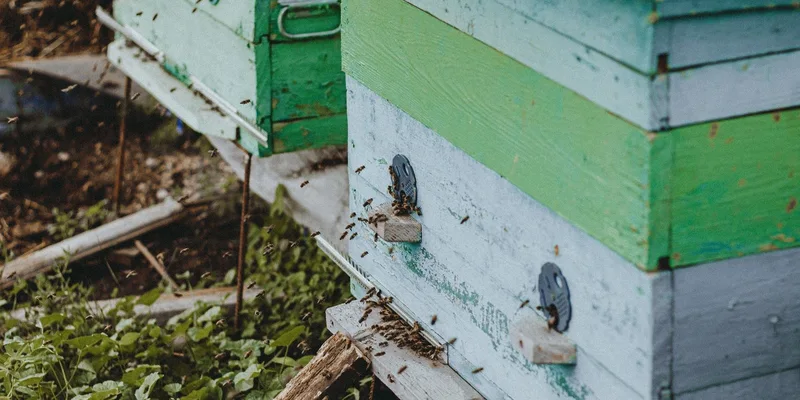
This is the whole comparison in one word. Robbing starts when bees from other colonies find sugar they do not have to work for, and the scent of syrup at the front of a hive is an open invitation. During a late summer dearth an entrance feeder on a weak colony can be the thing that starts the fight.
A pail feeder sitting under the outer cover keeps that scent inside the stack. Robbers have to get past the entrance, past the guards and up through the hive to find anything, and by then the colony has a real chance to defend itself. In a yard with several hives, this alone is usually the deciding factor.
When the Difference Does Not Matter
In a good spring flow, with forage everywhere and every colony busy, robbing pressure is low and an entrance feeder causes no trouble at all. Single-hive backyards with no neighboring apiary nearby are also a much softer case. The risk climbs sharply in dearth conditions and in yards where colonies sit close together.
Capacity and How Often You Refill
An entrance feeder holds a jar, usually a quart. For a package drawing comb in spring that is a daily errand, and daily errands get skipped. A pail feeder scales with the container, from a jar-sized version up to a bucket that keeps a colony going for a stretch without you lifting anything.
The refill routine differs too. The entrance feeder swaps from outside without disturbing the colony at all, which is genuinely convenient. The pail needs the outer cover lifted, the empty pail pulled and a full one set in place, which takes under a minute but does interrupt the hive.
Drowning, Waste and Cold Weather
Both designs score well on drowning, because the bees never meet an open surface of liquid. That puts them ahead of open tray top feeders and smooth-walled frame feeders on this particular measure, and it is the main reason a lot of keepers like the pail design.
Cold weather is where the entrance feeder falls apart. Syrup sitting at the entrance, exposed to the outside air, is colder than the hive and can be too cold for the bees to take even when the hive interior is mild. A pail sitting directly over the cluster stays close to hive temperature far longer into the fall.
Side by Side
Neither one is a bad product. They are simply built for different conditions, and most keepers who own both use them in different months.
| Point of comparison | Entrance feeder | Pail feeder | Why it matters |
|---|---|---|---|
| Robbing risk | High, syrup scent at the door | Low, syrup inside the stack | A robbing event can kill a weak colony in an afternoon |
| Capacity | One jar at a time | Jar up to a several gallon bucket | Decides how often you visit during buildup |
| Refilling | From outside, no disturbance | Lift the outer cover, swap the pail | Convenience against interruption |
| Cold weather use | Poor, syrup chills at the entrance | Better, sits over the cluster | Extends the useful feeding season in fall |
| Extra parts needed | None | Empty box or deep shim | The shim is a one-time purchase |
Which One Fits Your Situation
Best for a Single Hive in a Good Spring Flow
An entrance feeder with a visible jar lets you check the level from the path without opening or lifting anything, which is exactly what you want in the low-risk part of the year.

Best for Feeding Through a Dearth or in Fall
A large bucket feeder over the inner cover hole holds real volume and keeps the syrup scent entirely inside the hive during the months when robbing starts.
Best for a Nuc or a Small Colony
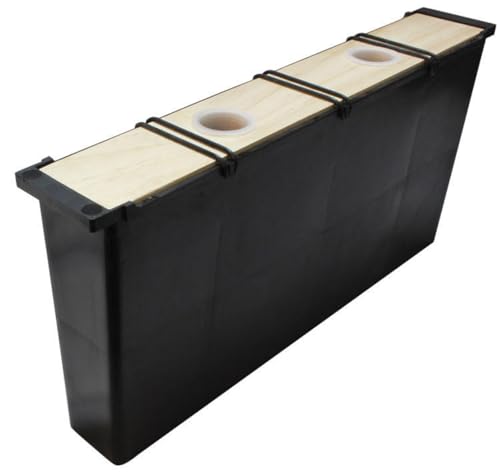
A quart-sized perforated lid jar feeder gives a small colony a manageable amount at hive temperature, without a bucket of syrup going sour above five frames of bees.

Mistakes People Make With Both
Punching the lid holes too large is the classic. If the perforations are big enough for the vacuum to break, the whole container runs out into the hive, which floods the colony and puts a puddle of syrup exactly where robbers will find it. Small holes, and a jar inverted over a sink until you trust it.
The other is leaving either feeder on when the colony has stopped taking syrup. Warm syrup ferments, the bees refuse it, and you now have a moldy container to clean and a lingering smell around the hive. Feed for a reason, then take the feeder off and wash it.
Frequently Asked Questions
Is an entrance feeder bad for bees? Not inherently. It is safe for the bees using it, and it drowns very few. The problem is location: syrup at the entrance attracts robbing bees and wasps, which is dangerous for weak colonies during a dearth.
How does a pail feeder work? Tiny holes in the lid plus an inverted container create a vacuum that holds the syrup in place. Bees feed through the perforations from underneath while air cannot get in fast enough to let the liquid pour out.
Do I need an empty box over a pail feeder? Yes, an empty hive body or a deep shim, so the outer cover can sit down flat over the pail. Without it the cover will not close and the feeder is exposed to weather and robbers.
Which feeder is better for a new package? A pail feeder, or a top feeder, because a package drawing comb goes through syrup faster than a single entrance jar can supply. Capacity and low robbing risk both point the same way here.
Can I use either one in winter? No. Bees cannot evaporate and cap syrup in cold weather, and an entrance feeder chills badly. Winter feeding switches to solid sugar placed directly above the cluster.
How do I stop robbing once it starts? Remove the syrup source, reduce the entrance so the guards have less to defend, and consider a robbing screen. Wet grass or a sheet over the hive is a common emergency measure while the frenzy settles.
The Bottom Line
Entrance feeder and pail feeder use the same vacuum trick, so the choice is really about where the syrup sits. A pail over the inner cover holds more, works later into the fall and keeps the scent inside the hive; an entrance feeder is unbeatable for checking levels at a glance in a low-risk spring. Own both, use the entrance version sparingly. Read next: our comparison of all four feeder types, and the frame feeder guide for the most robbing-resistant option of all.