
Last updated: August 21, 2026
The veil is the part of a bee suit you notice every single second you are wearing it. Fabric weight and pocket count fade into the background once you start reading frames; a veil that has drifted against your nose, or that fogs your glasses, or that puts a black bar across the exact spot you are trying to look at, does not fade into anything. It is the piece most likely to make a beginner give up on an inspection early.
Three designs cover almost everything sold: the fencing veil, the round veil on a brim hat, and the square or English hood. They protect similarly and behave quite differently, and most keepers develop a strong preference within a season. This guide explains what each one does, who tends to prefer which, and what to check before you commit to a suit that only ships with one.
This article contains affiliate links. If you buy through them, we may earn a commission at no extra cost to you. Learn more.
Quick Answer
Which beekeeping veil type should you choose?
- Fencing veil: zips flat to the collar, packs small, and is the default on most modern suits. Good all round, slightly closer to the face at the sides.
- Round veil on a brim hat: the widest, most even field of view and the most distance from your face. The usual pick for glasses wearers.
- Square or English hood: traditional, very good forward vision, bulkier and slower to put on.
- Buy a suit that includes two veils if you can. Preference is personal and nobody knows theirs in advance.
Bottom line: judge a veil on how far the mesh sits from your face and how well you can look down at a frame.
What a Veil Is Actually Doing
A veil keeps mesh at a fixed distance from your face and neck, and it does that with structure rather than fabric. Every design solves the same problem in a different way: hold black mesh far enough out that a bee landing on it cannot reach skin, keep it there when you bend forward, and let you see through it without the mesh reading as a wall.
Black mesh in front of the eyes is deliberate. Dark mesh cuts glare and effectively disappears at reading distance, while white mesh in front of your eyes would scatter light and make a frame harder to read. That is why almost every veil is white on the crown and black across the face panel.
The Fencing Veil
The fencing veil is a collar mounted hood with a rigid insert across the top that pushes the mesh forward, borrowed in shape from fencing masks. It zips to the suit or jacket at the shoulders, folds back flat when you want it off your head, and packs down small. It is the default veil on most suits sold today.
Its strength is speed and tidiness. You can unzip and throw it back one handed when you step away from the hive, and there is no separate hat to keep track of. Its weakness is that the rigid support is at the top only, so when you tip your head down to look into a box the side panels can come closer to your cheeks than a brim would allow.
Who Tends to Prefer It
Keepers who work fast, who move between several hives, and who value not losing a hat. It is also the easier veil to wear in wind, because there is no brim to catch. If you are buying one suit and one veil for a backyard colony or two, the fencing veil is the safe default.
The Round Veil on a Brim Hat
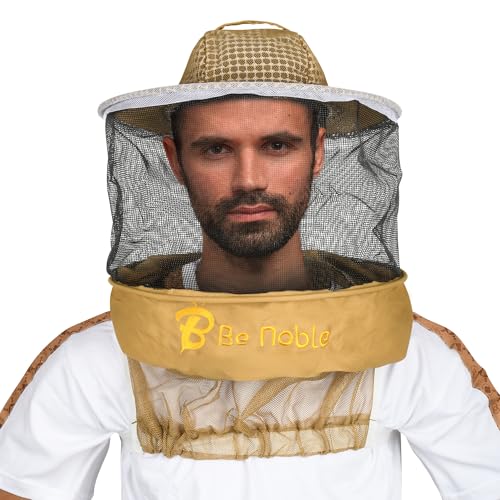
The round veil is a cylinder of mesh hung from the brim of a stiff hat, usually a pith style helmet or a woven hat, and drawn in at the shoulders. The brim holds mesh away from your face in every direction at once, which gives the widest and most even field of view of the three designs.
That even distance is why it is the common recommendation for anyone who wears glasses. There is no direction in which the mesh can drift onto your lenses, and the brim also shades your eyes, which helps when you are trying to spot eggs in a cell with the sun behind you. The costs are bulk, a hat that can catch wind, and slightly more faff getting in and out.
The Square or English Hood
The square veil, often called an English veil, uses a folding wire frame to create a boxy shape around the head with a flat panel in front of your face. Forward vision is excellent because the panel sits parallel to your eyes rather than curving away, and the traditional versions ring the shoulders with a drawcord.
It is the least common of the three on modern suits, mostly because it is bulkier to store and slower to don than a fencing veil. Keepers who grew up with it tend to stay with it, and it remains popular where the veil is worn as a separate item over ordinary clothes rather than as part of a coverall.
Comparing the Three Veil Types
| Veil type | Field of view | Distance from face | Best suited to |
|---|---|---|---|
| Fencing veil | Good forward, narrower at the sides | Held at the top only | Fast work, packing small, wind |
| Round brim veil | Widest and most even | Even in every direction | Glasses wearers, long inspections |
| Square English hood | Excellent forward, flat panel | Held by a wire frame | Traditional setups, veil worn alone |
| Attached suit hood | Varies by suit | Depends on the collar design | Keepers who never remove the veil |
Attachment: Zipper, Drawcord or Elastic
How the veil joins the suit is where protection is won or lost. A two way zipper that runs the whole way around the collar and closes past the corners is the strongest arrangement, provided the suit has a flap or a velcro tab over the zipper ends. Corners are where a gap opens, and where bees investigate first.
Drawcord veils that pull in under the arms and tie across the chest work well over ordinary clothes but need to be pulled properly tight every time. Elastic only versions are the quickest and the least reliable, because elastic relaxes with age and stops sealing against a moving shoulder.
Practical Checks Before You Buy
Look down as if reading a frame and see how close the mesh comes to your face. Turn your head fully to one side and check whether the veil turns with you. Put on your glasses or sunglasses if you wear them, then repeat both. Those three movements tell you more than any specification list will.
Then check the replacement path. Veils wear out faster than suits, because mesh snags and zippers fail, and a suit whose veil can be bought separately outlives one where the hood is stitched in. Suits that ship with two veils, common on ventilated models, sidestep the question entirely and let you settle your preference by using both. Our bee suit buying guide covers which formats include what.
Frequently Asked Questions
Which beekeeping veil is best for glasses wearers? The round veil on a brim hat, because the brim holds mesh at an even distance in every direction, so there is no head position where it can settle against your lenses.
Can you wear a bee veil without a suit? Yes, and square and round veils with a drawcord are designed for exactly that. Wear a light colored long sleeve shirt underneath and make sure the cord pulls tight enough that the veil cannot lift at the shoulder.
Why is bee veil mesh black in front of the eyes? Black mesh reduces glare and visually disappears at close range, so you can read a frame through it. White mesh in the same position scatters light and makes fine detail like eggs much harder to see.
Do veils fog up? Mesh itself does not fog, but glasses underneath a veil can, particularly on a humid morning. A veil that holds more air away from your face, such as a round brim, gives sweat and breath somewhere to go and reduces the problem.
Can bees sting through a veil? Only where the mesh touches skin, which is why the whole design is about standoff. Veils are sting-resistant because of the gap they hold, not because the mesh itself is impenetrable.
How do you wash a bee veil? Most veils are hand wash and air dry so the mesh keeps its shape, even when the suit itself is machine washable. Check the label for the specific product before putting a veil anywhere near a dryer.
The Bottom Line
Veil choice comes down to how far the mesh sits from your face and how well the design holds that distance when you look down at a frame. The fencing veil is the tidy default, the round brim veil is the pick for glasses and for long inspections, and the square hood is the traditional option with excellent forward vision. If you can, buy a suit that includes two so you can settle the question by wearing both. Read our bee suit buying guide for the fabric side of that decision, and the ventilated suit guide if summer heat is what pushed you to look in the first place.