Last updated: August 21, 2026
The reason a Langstroth hive works is not the wood, it is the standard. Any deep box from any supplier drops onto any bottom board from any other supplier, and a frame bought in one state fits a box built in another. That interchangeability only survives if everybody sticks to the same handful of measurements, which is exactly what trips up keepers who build their own boxes or mix salvaged equipment from two different sources.
This is the reference list: the outside sizes of the standard boxes, the frame heights that go in them, and the one measurement that matters more than any of the others. If you are cutting lumber or buying used gear, work from these and check them against the supplier you are actually ordering from before the saw comes out.
This article contains affiliate links. If you buy through them, we may earn a commission at no extra cost to you. Learn more.
Quick Answer
What are the standard Langstroth hive dimensions?
- A ten frame box measures about 19 7/8 inches long by 16 1/4 inches wide on the outside; an eight frame box keeps the same length and is about 13 3/4 inches wide.
- Box heights are 9 5/8 inches for a deep, 6 5/8 inches for a medium and 5 11/16 inches for a shallow.
- Frames run 9 1/8, 6 1/4 and 5 3/8 inches tall to match, all on a 19 inch top bar.
- Bee space, the gap the bees leave open instead of filling, is the reason all of it works.
Bottom line: length and bee space are non-negotiable; height is a choice, and width only has to match the rest of your stack.
Bee Space Is the Measurement Behind Every Other One
Bee space is the gap of roughly a quarter to three eighths of an inch that honey bees leave as a passage instead of filling it. Make a gap smaller than that and they seal it with propolis; make it larger and they build comb across it. Every dimension in a Langstroth exists to keep that gap consistent everywhere inside the hive.
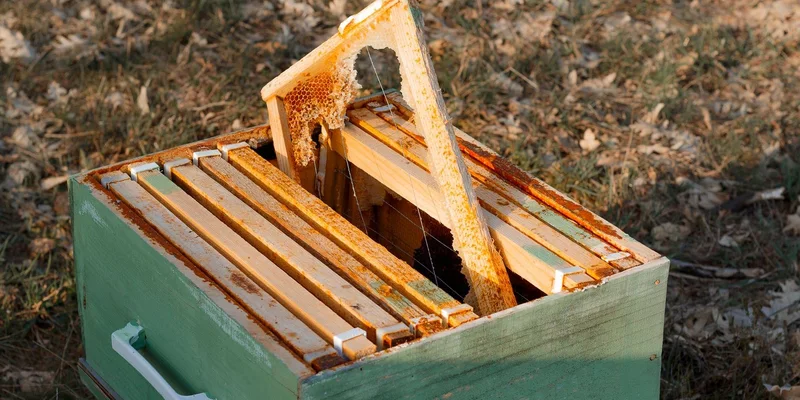
That is why a box that is a quarter inch too deep is not a small error. It turns the space above the frame top bars into a place where bees build burr comb, and every inspection afterwards means tearing that comb apart. When you check a used box or a homemade one, check the internal height against a frame before you check anything else.
Box Sizes: Deep, Medium and Shallow
Standard American Langstroth boxes come in three heights on the same footprint. A deep, also called a hive body or brood box, stands 9 5/8 inches tall. A medium, sometimes called an Illinois or western super, stands 6 5/8 inches. A shallow stands 5 11/16 inches. All three share the same length and width, so they stack in any order.
Length is the dimension that never changes: about 19 7/8 inches on the outside, because that is what a 19 inch frame top bar needs with a rabbet at each end. Width follows the frame count, roughly 16 1/4 inches outside for ten frames and 13 3/4 inches for eight. Mixing an eight frame box into a ten frame stack leaves an open ledge that bees will fill with comb, so pick one width per hive and stay with it.
Why Suppliers Quote Slightly Different Numbers
You will see 19 7/8 and 19 13/16 quoted for the same box, and both are correct depending on how deep the supplier cuts the rabbet and how thick the stock is. The internal dimensions are what matter to the bees. Order boxes and frames from the same standard family, confirm the frame length is 19 inches, and the small differences disappear.
Frame Dimensions That Go With Them
Frames are sized to their box with bee space left underneath. A deep frame stands 9 1/8 inches, a medium 6 1/4 inches and a shallow 5 3/8 inches, and every one of them sits on a top bar 19 inches long that rests in the rabbets at each end of the box. End bar width, usually 1 3/8 inches, is what spaces the combs correctly across the box.
That end bar width is quietly important. It sets comb-to-comb spacing in the brood nest, and it is why you can run nine frames in a ten frame honey super to get fatter comb for uncapping but should not do the same in the brood nest. Our beehive frames guide goes through the plastic, wooden and foundationless options that all share these same outside measurements.
The Standard Sizes in One Table
Here are the numbers you will use most often, in the form you need them when you are ordering or cutting. Every supplier of standard Langstroth equipment builds to these, which is what makes the system worth staying inside.
| Box | Outside height | Frame height | Usual job |
|---|---|---|---|
| Deep (hive body) | 9 5/8 in | 9 1/8 in | Brood nest, winter stores |
| Medium (Illinois) | 6 5/8 in | 6 1/4 in | Honey super, or the whole hive in an all medium setup |
| Shallow | 5 11/16 in | 5 3/8 in | Light honey supers, comb honey |
| All three | 19 7/8 in long | 19 in top bar | Length is fixed across every box height |
The Parts Above and Below the Boxes
A bottom board, an inner cover and a telescoping outer cover all share the same footprint as the boxes they serve, with the outer cover sized to overhang. The inner cover carries bee space on at least one face, which is why it has a right way up, and the notch in its rim can act as an upper entrance when it faces forward and up.
Screened bottom boards, migratory covers and slatted racks all keep the same length and width, so they slot into the stack without adapters. The only dimension you have to watch is the height of anything that sits directly over the frames, because that is where bee space gets lost and burr comb starts.
Building Your Own Boxes
Homemade boxes are one of the better winter projects, and the ones that fail all fail the same way: the internal height is wrong, or the rabbet is cut too shallow and the frames sit proud. Cut to the internal dimensions first and let the outside fall where the stock thickness puts it.
Use lumber that will hold up outdoors without treating the inside, keep joints square so boxes seal against each other, and build a test box before you build ten. Then check a real frame into it, sitting on the rabbets, and measure the gap above the top bars and below the bottom bars. If both read close to a bee space, the rest of the build is carpentry.
Matching Used Equipment
Secondhand boxes are usually standard, but ten frame and eight frame gear looks similar in a photograph and is not interchangeable. Measure the width before you buy, and ask what the boxes held. Comb and boxes from a colony lost to brood disease are a question for your state apiarist before anything moves into your yard, which is covered in our guide to eight and ten frame hives.
Frequently Asked Questions
How tall is a Langstroth deep box? A standard deep is 9 5/8 inches tall on the outside and takes a frame 9 1/8 inches tall, leaving bee space above and below the comb.
Are eight frame and ten frame boxes interchangeable? The frames are, the boxes are not. Both use the same 19 inch top bar, but an eight frame box is narrower, so it will not seal against a ten frame box in the same stack.
What is bee space in a Langstroth hive? The gap of roughly a quarter to three eighths of an inch that bees leave open as a walkway. Smaller gaps get propolized shut, larger ones get filled with comb.
Can I build Langstroth boxes from any lumber? Any stable, weather-tolerant softwood works if you cut to the correct internal dimensions and keep the joints square. Match the internal height first and let the outside dimension follow your stock thickness.
What size frame fits a medium super? A 6 1/4 inch frame on a 19 inch top bar. That same frame is the only one you stock if you run an all medium hive.
Do all suppliers use exactly the same dimensions? Close enough to interchange, with small differences in rabbet depth and stock thickness. Buy boxes and frames within one standard family and confirm the 19 inch top bar length.
The Bottom Line
Langstroth dimensions are worth memorizing because they are the reason the system works at all: a 19 inch top bar, a 19 7/8 inch box, three heights to choose from, and a bee space that has to survive every joint in the stack. Get those right and any box fits any other. For what goes inside them, see our beehive frames guide, and for the box height decision itself read all mediums or deeps and supers.