Last updated: August 21, 2026
Open any beekeeping catalog and you are looking at a wall of rectangular boxes with slightly different depths, frame counts and names, all of them described as if you already know what they do. That is the Langstroth hive, and the reason it looks confusing on a product page is that it is not one object. It is a stack of interchangeable parts, and the stack changes shape three or four times a year as the colony grows and shrinks.
Once you see the hive as a stack rather than as a product, the catalog stops being intimidating. This guide walks the whole thing from the ground up, box by box, and explains what each layer is actually for, why deeps and mediums exist, what bee space has to do with any of it, and which parts you can decide later.
This article contains affiliate links. If you buy through them, we may earn a commission at no extra cost to you. Learn more.
Quick Answer
What is a Langstroth hive?
- A vertical stack of open-ended boxes, each holding removable frames, sitting on a bottom board and closed by an inner cover and an outer lid.
- The lower boxes hold the brood nest, the boxes you add on top are honey supers, and you add or remove supers as the season goes.
- Every box in the same width is interchangeable, which is the whole point: parts from different suppliers fit together.
- It is the standard hive in the United States, so frames, feeders, excluders and mite gear are all built to fit it.
Bottom line: learn the stack once and the rest of the equipment world lines up behind it.
What a Langstroth Hive Actually Is
A Langstroth hive is a set of bottomless, topless wooden or plastic boxes stacked on top of each other, each one holding a row of removable frames that hang from a rabbeted lip. The colony builds comb inside the frames, so you can lift out any single frame, look at it, and put it back without cutting anything.
That removability is the entire invention. Before it, inspecting a colony meant destroying comb. The design also standardized the outside measurements, which is why a super bought from one supplier sits square on a brood box bought from another, and why almost every accessory on the market is built to those dimensions.
The Stack From the Ground Up
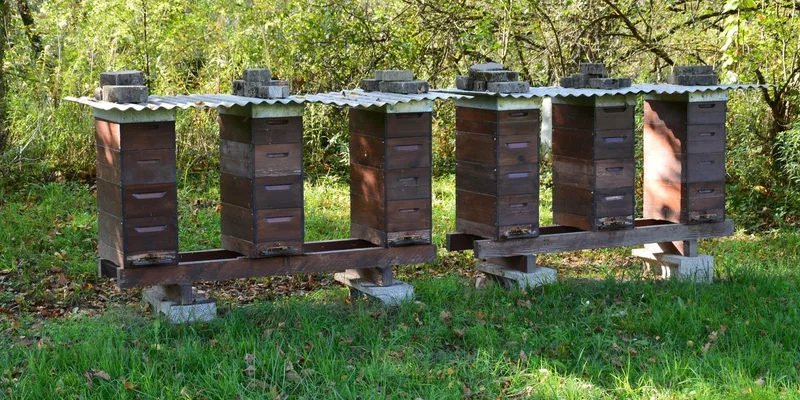
Read the hive from the bottom and it makes sense in one pass. Stand, bottom board, brood boxes, queen excluder if you use one, honey supers, inner cover, outer cover. Each layer has one job, and only the middle section changes through the year as the colony expands and contracts.
Stand and Bottom Board
The stand lifts the hive off wet ground and sets the working height of your back. On top of it sits the bottom board, the floor of the hive, with a slot at the front that becomes the entrance. Screened bottom boards swap the solid floor for mesh, which improves airflow and lets debris fall through instead of collecting. An entrance reducer, a small strip of wood with a notch cut in it, narrows that opening while a colony is small or the weather is cold. Getting the stand right is worth some thought, and our beehive stand guide covers height, leveling and ants.
Brood Boxes and Honey Supers
The boxes directly above the bottom board are the brood nest, where the queen lays and the colony stores the food it lives on. Boxes added above that are honey supers, and their contents are what you eventually harvest. Physically they are often the same box. What makes a box a super is where it sits in the stack and what the bees put in it, not a different product on the shelf.
Deeps, Mediums and Shallows
Langstroth boxes come in three standard depths, and the difference is only height. A deep, also called a hive body, measures 9 5/8 inches. A medium super measures 6 5/8 inches. A shallow measures 5 11/16 inches. Length and width stay the same across all three, so they stack in any order you like.
The practical reason the three depths exist is weight. A deep packed with capped honey is genuinely heavy, heavy enough that plenty of backyard keepers cannot lift one off a stack comfortably, and that single fact drives more equipment decisions than anything else in beekeeping. A lot of keepers run all mediums for exactly this reason: every box is the same, every frame is interchangeable, and nothing you lift is at the top of your range.
| Box | Depth | Usual job | Handling note |
|---|---|---|---|
| Deep | 9 5/8 in | Brood nest, sometimes overwintering stores | Heaviest box when full, two people or a hive lift |
| Medium | 6 5/8 in | Honey supers, or the whole hive in an all medium setup | Most popular compromise for backyard keepers |
| Shallow | 5 11/16 in | Comb honey and light honey supers | Easiest to lift, needs more boxes for the same volume |
| Nuc box | Usually deep | Five frame starter colony, splits, swarm catching | Small enough to carry loaded, see our nuc guide |
Eight Frame or Ten Frame
The other choice on every product page is width. A ten frame box is the traditional size and the one most catalogs default to. An eight frame box is narrower, holds two fewer frames, and weighs correspondingly less when full. Both use identical frames, so the frames themselves are not part of the decision.
Pick one and stay with it. Mixing widths in the same apiary means covers, excluders and spare boxes stop being interchangeable, which is annoying in the middle of an inspection when you need a lid that fits. Eight frame gear suits smaller people, higher stands and anyone who expects to move boxes alone. Ten frame gear gives the colony more room per box and is easier to buy secondhand.
Bee Space, and Why the Gaps Matter
Bee space is the gap the design is built around, roughly three eighths of an inch, and it is why the frames come out cleanly instead of being glued in place. Give bees a gap wider than that and they fill it with comb. Give them a gap narrower than that and they seal it with propolis, the sticky resin they use as caulk.
Every dimension in a Langstroth hive respects that gap: between frames, between the frame tops and the box above, between the outer frames and the box walls. It also explains a common beginner surprise. Leave a frame out, or space frames unevenly, and the colony will build wild comb across the gap within a couple of weeks, which then tears when you lift the frame.
What Goes Inside the Boxes
Boxes are empty shells. Frames are what actually hold the colony, and they come in matching depths, wood or plastic, with wax coated plastic foundation, wired wax foundation, or nothing at all for foundationless keepers. Foundation is the starting sheet the bees draw comb onto, and it sets the cell pattern.
Frames are also the part you will keep buying, because comb ages, gets damaged and eventually gets rotated out. It is worth understanding the differences before your first order rather than after, and our beehive frames guide compares plastic, wood and foundationless side by side. The same goes for the queen excluder, the flat grid that sits between brood boxes and supers and keeps the queen out of your honey.
What the Woodenware Does Not Include
A hive kit is furniture. It does not include bees, and it does not include the gear you need to open the hive safely. The two things you will reach for on every single visit are protection and smoke, and neither ships inside a box of woodenware unless the listing says so explicitly.
Before your first colony arrives, you want a bee suit that actually fits, a smoker you can keep lit, and a hive tool. If you are still building the whole list, our starter kit guide walks through what is worth buying bundled and what is better bought on its own.
Frequently Asked Questions
How many boxes does one hive need? Most backyard colonies overwinter in one or two brood boxes and get honey supers added on top during the flow. You start with one box, add the second when the first is mostly drawn and full of bees, and add supers from there.
Are deep and medium frames interchangeable? No. Frames match their box depth. A medium frame in a deep box leaves a large gap underneath, and the colony fills that gap with comb hanging off the bottom bar.
Do I need a queen excluder? It is optional and keepers disagree about it. It keeps brood out of harvest frames, and some keepers find it slows the bees moving up into supers. Our excluder guide covers both sides.
Can I mix eight frame and ten frame equipment? The boxes will not stack squarely, so in practice no. Frames are shared between both widths, but covers, excluders and boxes are not.
Is a Langstroth hive the best choice for a beginner? It is the most supported choice, which matters more than it sounds. Parts, mentors and club advice all assume it.
Wood or polystyrene boxes? Pine is the default and easy to repair. Polystyrene insulates better and weighs less, but it dents and needs a coating.
The Bottom Line
A Langstroth hive is a stack, not a product: bottom board, brood boxes, supers, cover, with removable frames inside every box and a standardized gap holding the whole logic together. Decide your box depth and your frame width early, keep the whole apiary consistent, and the rest of the equipment world will fit. Read also our comparison of hive types if you are still weighing Langstroth against top bar or Warre, and our starter kit guide for the gear that goes around the boxes.