Last updated: August 21, 2026
Every beginner runs into the same fork within a week of deciding to keep bees. One tab has a single bundle that promises everything needed to start. The other has a shopping list assembled from a club handout, a forum thread and two supplier catalogs, with fourteen items in it and no certainty that they all fit together.
Neither route is wrong, and the honest answer is that most beekeepers end up doing both without planning to. What matters is knowing which items reward bundling and which ones punish it, because the difference shows up on the first warm afternoon you actually open a hive.
This article contains affiliate links. If you buy through them, we may earn a commission at no extra cost to you. Learn more.
Quick Answer
Should you buy a beekeeping starter kit or the pieces separately?
- Bundle the woodenware and the basic tools, because those are commodity items and a kit guarantees they fit each other.
- Buy protective clothing separately, since fit and ventilation vary hugely and kits ship one generic size.
- Buy the smoker separately if the kit includes a small one, because a smoker that goes out mid inspection is worse than none.
- Add the second brood box and a feeder yourself; kits rarely include either and both are needed in the first season.
Bottom line: kit for the boxes and the small tools, separate purchases for anything you wear or rely on to stay lit.
What Each Route Actually Gets You
A kit gets you compatibility and one delivery. Everything in the box was chosen to work together, which removes an entire category of beginner error: frames that do not fit boxes, covers sized for the wrong width, foundation that does not match the frame style you ordered. That is genuinely valuable on a first order.
Buying separately gets you control over the two or three items where quality varies most, and it lets you skip whatever you will never use. The trade is time, several orders, and the risk of discovering in April that your eight frame boxes came with a ten frame cover.
Where Buying a Kit Wins
Kits win on woodenware and on small hand tools. Boxes, frames, bottom boards, inner covers and outer covers are standardized products where a bundle removes the sizing risk entirely. Hive tools, bee brushes, frame grips and queen clips are inexpensive commodity items that nobody upgrades for quality reasons.
The Compatibility Problem Is Underrated
Woodenware comes in widths, depths, frame styles and foundation types that all have to agree with each other. Ten frame boxes need ten frame covers. Deep frames need deep foundation. Plastic foundation needs frames grooved for it. A first time buyer assembling this from three suppliers will get at least one of those wrong.
A bundle turns that into someone else’s problem. For a first hive, that is worth more than saving a few dollars per box, especially in a spring where bees are already ordered and a wrong delivery means a two week delay.
The Bundle Worth Buying
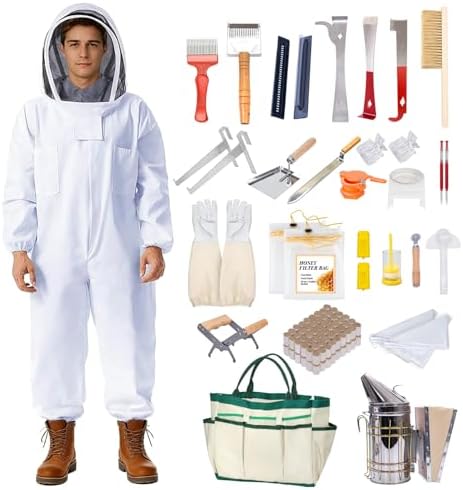
The bundles that actually earn their place pair assembled or flat pack woodenware with the small tools, rather than padding the box with novelty accessories. Look for a bottom board, inner cover and telescoping outer cover in the listing, plus frames with foundation already fitted.
Where Buying Separately Wins
Separate purchases win on anything you wear and anything with a moving part. Protective clothing, gloves and the smoker are the three items where the difference between the bundled version and a decent standalone version is felt on every single inspection, and where kits reliably economize.
Clothing Is a Fit Problem, Not a Bundle Problem
Suits are sized against a chart that varies by manufacturer, and the difference between a suit you tolerate and one you avoid is mostly fit and airflow. A single layer cotton suit in a generic large is what most kits ship. A three layer ventilated suit ordered to measurements is what people who inspect regularly in July actually wear.

A Small Smoker Is a False Economy
Smokers are simple objects with one job, and the small ones fail at it. A larger firebox holds more fuel, a heat shield keeps the outside safe to grip, and a bellows with a decent spring keeps air moving without constant pumping. A smoker that dies halfway through an inspection turns a calm hive into a hurried one.

Kit Versus Separate, Item by Item
The table below splits the standard first year shopping list into the items where bundling helps and the ones where it hurts. Anything in the separate column is worth a few minutes of comparison rather than accepting whatever arrives in the box.
| Item | Better in a kit | Better separately | Why |
|---|---|---|---|
| Boxes and frames | Yes | No | Compatibility risk is the main hazard |
| Hive tool and brush | Yes | No | Commodity items, quality barely varies |
| Suit, veil, gloves | No | Yes | Fit and ventilation decide whether you wear it |
| Smoker | No | Yes | Firebox size and bellows quality vary a lot |
| Feeder and second box | Rarely included | Yes | Needed in the first season either way |
The Split Most Beekeepers End Up With
The common landing point is a hive and tool bundle for the hardware, a separately ordered suit sized from a chart, a full size smoker, and a second brood box plus a feeder added to the same cart. That covers a first colony without leaving obvious gaps or buying anything twice.
Mite monitoring gear is the piece people forget in both routes, because no kit includes it and no beginner list puts it near the top. It belongs on the first order regardless of which route you take, and our guide to counting mites by alcohol wash or sugar roll explains what the gear is for before the first summer.
The Mistake Both Routes Share
Buying extraction equipment in the first order is the mistake that survives either strategy. Kits sometimes bundle an extractor, and shopping lists often include one because harvesting is the part everyone pictures. A first year colony on new foundation usually spends the season drawing comb and building winter stores rather than producing a surplus.
Wait until you have capped honey frames you can point at. By then you will also know whether you want to buy one, borrow from a club, or split the cost, and our honey extractor guide covers that decision properly. Our breakdown of what beekeeping costs to start and to keep going puts the rest of the first year list in order.
Frequently Asked Questions
Is it cheaper to buy a beekeeping starter kit or separate pieces? Bundles are usually the cheaper route for woodenware and small tools because of shipping and packaging alone. Separate buying wins when a kit forces you to pay for a suit or an extractor you were going to replace or never use.
What beekeeping supplies do beginners actually need first? A complete hive with two brood boxes, a suit or jacket with a veil, a smoker with fuel, a hive tool, a feeder and a way to monitor mites. Everything beyond that can wait for a real problem to justify it.
Are the tools in cheap beekeeping kits any good? Hive tools, brushes and frame grips from budget kits are generally fine, since they are simple stamped or molded items. Smokers and clothing are where budget bundles show their limits most clearly.
Do I need gloves if the kit includes them? The bundled pair is usually thick leather with long gauntlets, which is protective and clumsy. Many keepers move to thinner gloves for feel once they are calmer around bees, which is covered in our glove guide.
Should I buy two of everything for two hives? Two hives means two sets of woodenware, two feeders and two entrance reducers, but only one smoker, one hive tool and one suit. Duplicating the tools is the most common way a two hive budget doubles unnecessarily.
The Bottom Line
Bundle the parts that have to fit each other and buy separately the parts you wear or depend on mid inspection. That single rule resolves most of the kit versus pieces debate, and it leaves you with a first setup that works instead of one that technically arrived complete. Next, read what is worth buying together in a starter kit and what belongs in the tool bucket.