Last updated: August 21, 2026
Most beekeepers start with a standard flat hive tool because that is what comes in the starter kit, and most of them end up with a J hook in their hand within two seasons. It is one of the few upgrades in this hobby that people describe the same way almost word for word: they did not think it would make much difference, and then it did.
The difference is not about strength or steel quality. It is about the direction the force travels. A flat bar lifts a frame by prying sideways against the neighboring frame or the box wall. A J hook lifts it straight up from underneath. That single change in geometry is what protects comb, spares bees and keeps frame ears from splitting.
This article contains affiliate links. If you buy through them, we may earn a commission at no extra cost to you. Learn more.
Quick Answer
Is a J hook hive tool better than a standard one?
- For lifting frames, yes. The hook goes under the frame ear and levers upward against the box rim, instead of prying sideways into the next comb.
- For heavy scraping and separating stuck boxes, the flat standard tool still has the advantage, because it takes more brute force without bending.
- Most backyard keepers end up carrying both, with the J hook as the tool in hand and the flat one in the bucket.
- If you are buying only one, buy the J hook, since routine inspections are mostly frame work.
Bottom line: the J hook wins on frames, the flat tool wins on force, and the pair costs little enough that most people stop choosing.
What the Hook Actually Changes
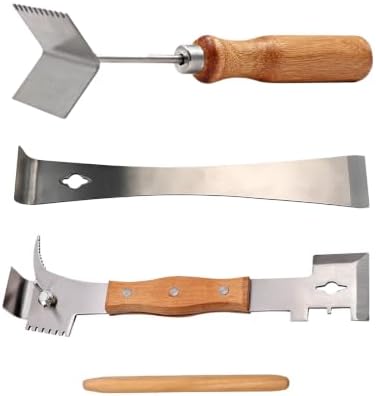
The J hook is a right angled hook bent out of the end of the bar. You slide it down between two top bars, catch the underside of the frame ear or the bottom of the top bar, and press down on the handle. The box rim becomes the fulcrum and the frame comes straight up, out of the propolis that was holding it.
With a flat tool you do the same job differently: you wedge the blade between two frames and twist, which pushes the target frame up while pushing the neighboring frame sideways. That neighbor is usually covered in bees, and sometimes in fresh comb. The J hook removes the sideways component entirely.
Why That Matters for the Bees
Rolling bees, meaning crushing them between two moving surfaces, is one of the more avoidable ways to lose workers during an inspection, and it also risks the queen if she happens to be on the face of the comb you just squeezed. Lifting straight up gives the bees time to move and keeps the gap between combs from closing.
Where the Standard Flat Tool Still Wins
A flat hive tool is a better lever for anything that needs real force. Separating a honey super that has been propolized to the box below all summer, chiseling burr comb off rims, cleaning the floor of a deadout, popping a stuck inner cover: these are jobs where a straight blade transmits force better than a hook does.
The hook also gets in the way in tight quarters. Scraping the inside face of a box or working the corner of a bottom board is easier with an uninterrupted blade, and a hook end is one more thing to snag on a frame rest when your hands are already full.
The Comparison in One Table
Both tools do most jobs adequately. The table below is about which one you actually want in your hand for each task during a normal backyard inspection.
| Task | J hook | Standard flat | Which to reach for |
|---|---|---|---|
| Lifting the first frame | Hooks under the ear, lifts straight up | Pries sideways against a neighbor | J hook |
| Breaking boxes apart | Works, less leverage | Full blade, best leverage | Flat |
| Scraping burr comb | Fine on the flat end | Better on flat surfaces | Flat |
| Packing smoker fuel | Both work equally | Both work equally | Whichever is in hand |
Which One to Buy
If You Are Buying a Single Tool
Buy the J hook in stainless, in a color you can find in the lawn. It handles the part of the inspection you do the most, and its flat end still scrapes well enough that you will not feel stranded until you hit a genuinely stuck super.

If You Already Own a Flat Tool
Adding a J hook is the cheaper half of the pair, and it changes how the frames come out rather than duplicating what you already have. Keep the flat one for demolition and cleanup work, where the hook is a liability rather than a feature.

Starting From Scratch
Sets that pair a J hook with a standard flat tool cover both roles in one order, and they usually work out cheaper than buying the two separately. It is the pragmatic answer to a comparison that most keepers eventually resolve by owning both.
Technique, and Where People Go Wrong
The most common mistake with a J hook is treating it like a flat tool: sliding it in and twisting. The hook is not designed to twist and will eventually deform if you use it that way. Slide it in, catch the underside of the frame, then press the handle down toward the box.
The second is using it on both frame ears at once by hopping side to side too quickly. Loosen one end, then the other, then lift with your fingers or a frame grip. Trying to lever a whole frame out on one end tilts the comb and puts stress on the ear that eventually cracks it.
When the Frame Will Not Move at All
If a frame is genuinely cemented in place, more force is the wrong answer. Loosen the frames on either side first so the target has somewhere to move into, give the propolis a moment, and work in small increments. Frames that will not budge in cold weather often come free easily on a warm afternoon, because propolis is brittle when cold and pliable when warm.
Frequently Asked Questions
What is a J hook hive tool used for? Lifting frames. The hooked end reaches under the frame ear or the top bar, and pressing the handle down against the box rim raises the frame straight up without prying sideways into the neighboring comb.
Do I still need a regular hive tool if I have a J hook? For a single hive you can manage with just the hook, but a flat standard tool is the better lever for separating stuck boxes and scraping, and the two together cover everything a backyard inspection asks for.
Does a J hook bend? A stainless hook used as intended holds up well. Bending happens when the hook is twisted like a flat blade or used to lever a whole box, which puts force across the bend rather than along it.
Which end do I use for scraping? The flat, chisel style end opposite the hook. Keep the hook itself for frames, since a hook dragged across a box rim catches on frame rests and gouges woodenware.
Is a frame lifter the same thing as a J hook? No. A J hook levers a frame up; a frame lifter or frame grip clamps the top bar so you can lift the frame out with one hand. They solve related problems and many keepers carry both.
What size J hook should I get? Standard lengths suit standard Langstroth equipment, and the practical variable is how the handle fits your hand in gloves. If you work in thick leather gloves, a wider grip section is worth more than a longer bar.
The Bottom Line
The J hook wins the frame lifting argument on geometry alone, and that is the job you do most often. The flat standard tool keeps its place for prying, scraping and the messier end of hive maintenance. Buying both is the honest recommendation, since the pair is cheap relative to everything else in the apiary. Our hive tool buying guide covers the full range of shapes, and the tool kit guide puts them in context with the rest of the bucket.